
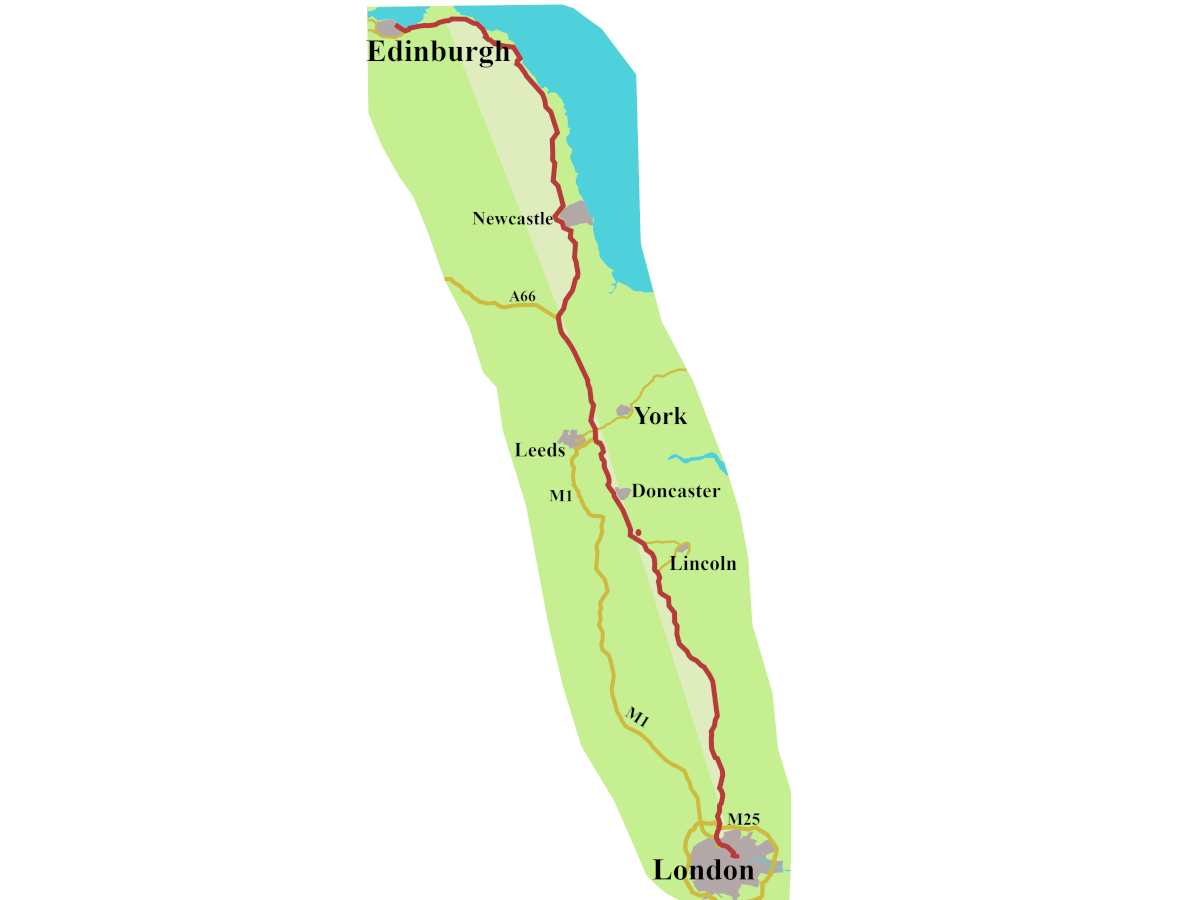
This first post is about what happened to the A1 between when it got its number, in 1923, to the road we have today.
[There will be an article later on how the road numbers came about.]
The A1 is the longest road in Britain, and one of the oldest. Some of it is Roman, though it’s possible stretches existed even before they arrived. Not the A1, of course, but the beginnings of the North Road, which is what it was held to be, for, getting on for, two thousand years. As the highway which connects the capital cities of two kingdoms, through the ages, armies have marched it, kings have travelled it, and people of note have voyaged it. Then there is the countless number of folk who have gone up and down it, but left no record, no trace. We must not forget, it is these nameless people who are, far and away, the overwhelming majority of those who have used The North Road, and still do.
How Many North Roads?
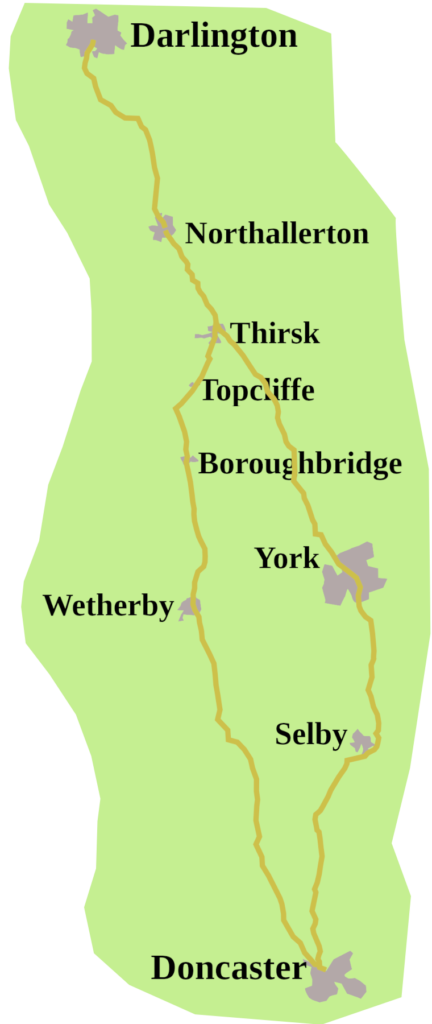
One of the decisions the newly created Ministry of Transport faced, just after the First World War, was the where the A1, pivotal to the whole scheme, should run. Such a thing sounds bizarre to us today, but in the nineteenth century, you could use a number of routes, and still feel you were on The North Road.
Heading north, for Edinburgh, after Doncaster, you might go via Selby, to reach York. From there it was by Thirsk and Northallerton to reach Darlington. More and more though, during the coaching era, the mail had missed out York to go through Wetherby, Boroughbridge, and Topcliffe to reach Northallerton.
Great or Old North Road
Heading south, even at the height of the coaching boom, the road divided at Alconbury, outside Huntingdon. The left fork took you along The Old North Road, through Huntingdon, Royston, and Ware, arriving in London by Bishopsgate.
(South of Royston, what was the Old North Road is now the A10, and I will devote future posts to it)
The right fork, the Great North Road, went through Baldock and Hatfield, then Potters Bar, Barnet, Whetstone, and Finchley, and so into London along the Holloway Road and Islington.
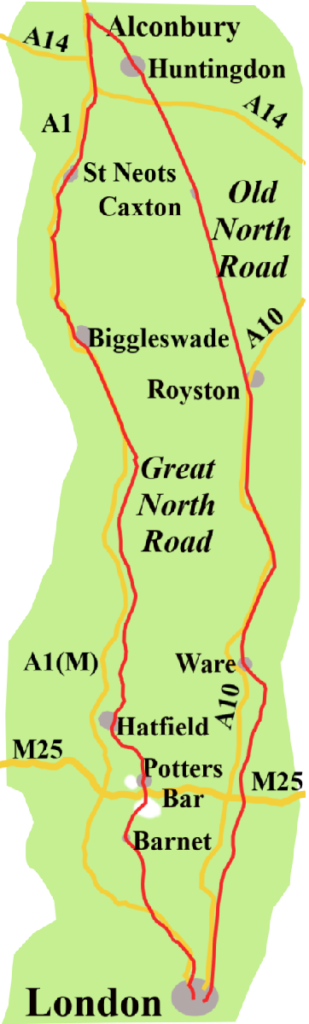
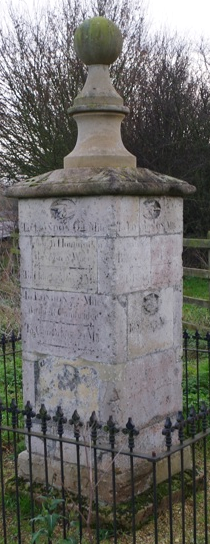
The stone marker, which stood where the two ways separated, has been moved to stand beside the B1043, once the Great North Road, near, what was, the Alconbury airbase. It informs southbound travellers that, to reach London by the Old North Road, they still had sixty-five miles to go, while by the Great North Road it was sixty-eight.
The A1 Arrives, but it’s not Right
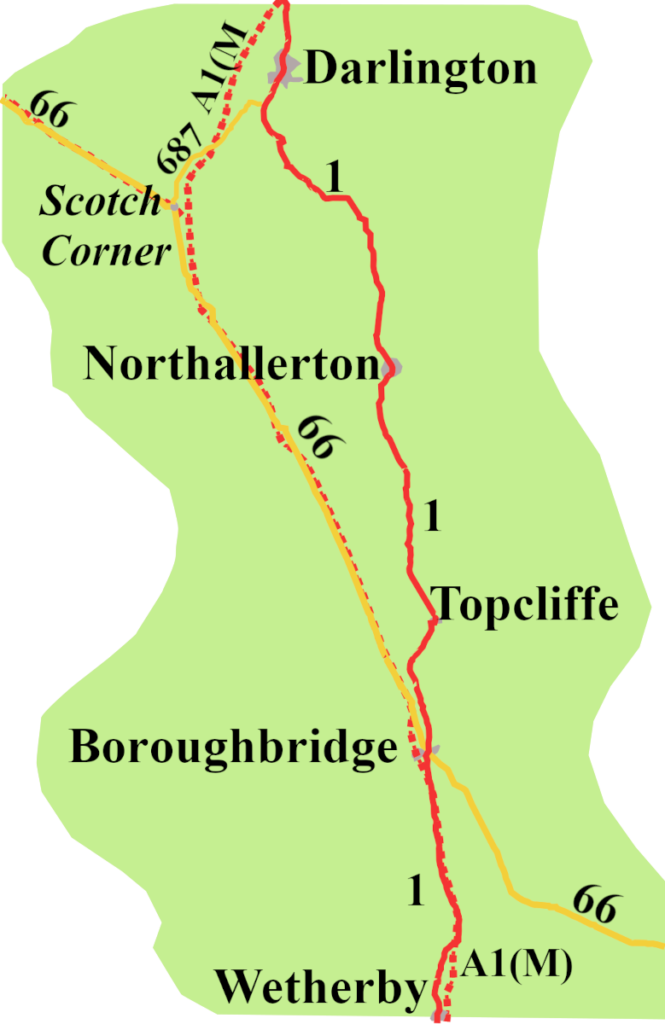
On 1st April 1923, the list of road numbers, and accompanying Ordnance Survey maps, were finally published. What they showed was, the A1 would follow the Great North Road past Alconbury. It would not go to York, but reach Darlington through Boroughbridge, Topcliffe and Northallerton.
Such a route may have been convenient in the days of stagecoaches, but not for cars. There must have been shaking of heads and sucking of teeth at the ministry, but they decided something must be done.
As it happened, there was another road, known as Leeming Lane, running north from Boroughbridge, following the line of a Roman road, called Dere Street. On the official map, Leeming Lane was numbered A66, which ran from Hull, through York, to Penrith.
Perhaps they could move the A1?
Radical! But, it’s what they did. By the end of 1924 the A1 ran along Leeming Lane as far as Scotch Corner, before heading north-east to Darlington. This was a novel route for the North Road, though today, it seems it was the way the A1 must always have gone, but of course, it wasn’t.
Bypasses and other Disruptions
Needless to say, it wasn’t the end of the matter. Leaving London, the A1 continued to follow the line of the Great North Road, through Barnet and Potters Bar, until 1927.
Then, the Barnet Bypass opened. It started where Archway Road met North Hill, coming up through Highgate Village. Here, you took a left turn off the A1, onto a new stretch of road which took you to the North Circular. After about half a mile, you turned right onto Great North Way, and on to Watford Way. It was initially given the number A5903, which seemed bizarre to me, until someone at SABRE pointed out that, at the time, the ministry simply gave new roads the next number on their list.
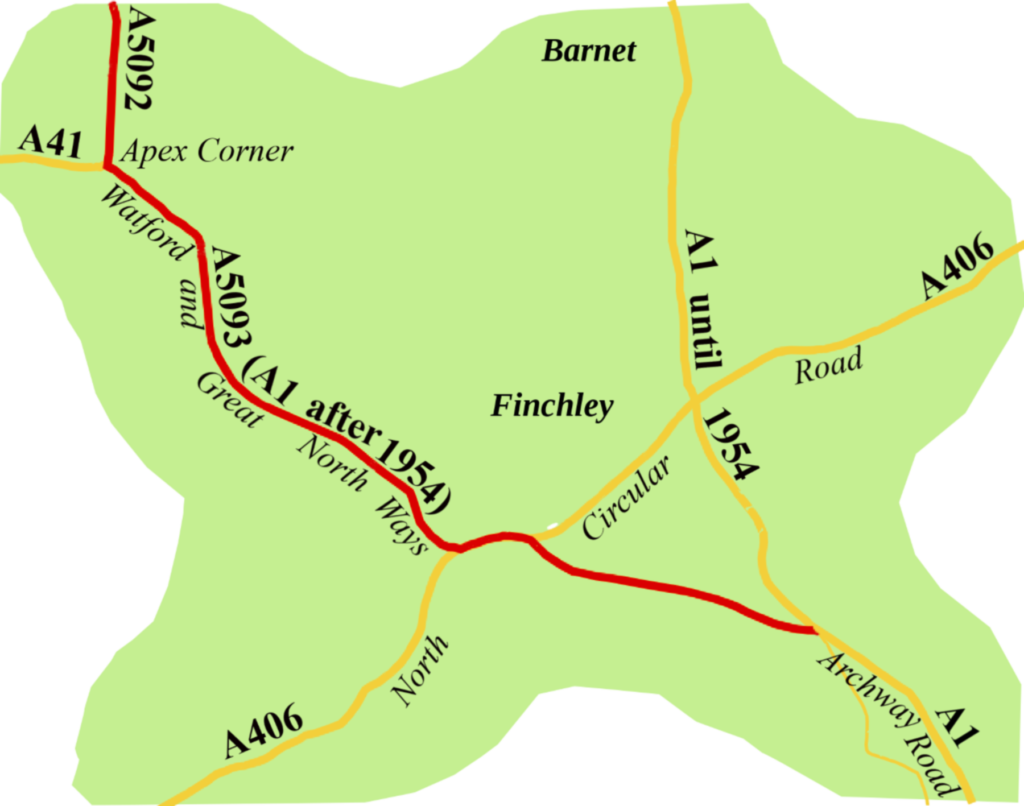
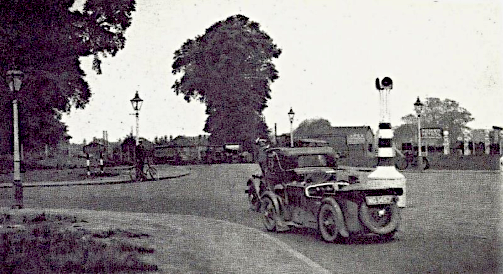
Next you would look out for a further right turn, already known as Apex Corner by the 1920s. Now you were on the southern end of the A5092, which fed you back onto the A1, just beyond Hatfield.It was the blueprint for the A1, as we now have it. In fact, it became the way you would have been most likely to choose through the 1930s and 40s. By 1937 the Barnet Bypass had been renumbered A555, and was part of the London to Edinburgh trunk route, even though the A1 still ran from Highgate, through Barnet, to Hatfield. It was not until 1954, the year after Queen Elizabeth II’s coronation, that from the top of Archway Road past Apex Corner to Hatfield was numbered A1. The original Great North Road route, through Barnet and Potters Bar, became the A1000, as it is today.
The A1 was never given time to settle. More than fifteen bypasses had arrived before the outbreak of World War Two.
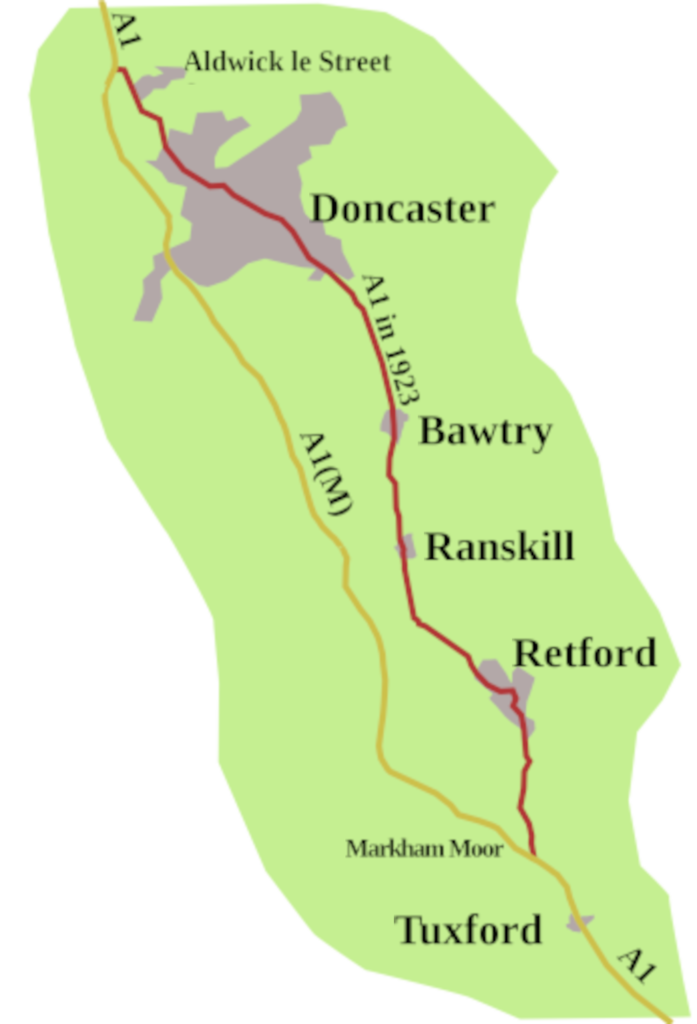
The war put abreak on things, but it all got going again at the beginning of the 1960s. One of the most significant changes was the Doncaster Bypass, opened in the summer of 1961, which put the A1 onto an entirely new route from Markham Moor to Aldwick le Street. As a result, not only Doncaster, but towns such as Retford and Bawtry were no longer on the A1.
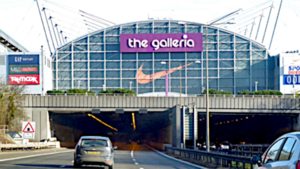
By 1970 Darlington and Durham were bypassed when the road just north of Scotch Corner was upgraded to motorway standard. And then, in the south the A1 had to accommodate the coming of the M25. By the end of 1975, Bignell’s Corner, a three-level roundabout where the M25 crosses the A1, was being built. It marked the southerly limit of the A1(M), though Junction 1 was not fully there until 1979, and it would take another seven years for the A1(M) to join up with the Stevenage Bypass. Then one day in late 1986, as we drove towards London on the A1, Hatfield had disappeared, and we simply sped through the Galleria tunnel. It was somehow unnerving.
“Improvements” continued, often causing frustration and annoyance. But, as with banging your head on the wall, it was better when it stopped. Between the A14 spur at Alconbury, (which has since become the A3107) and the A 605 junction for Peterborough, the road was upgraded to motorway standard in 1998, to give a ten-mile stretch with four lanes in each direction. By the end of the first decade of the twenty-first century, all the roundabouts, between Buckden and the one giving access to Berwick-upon-Tweed, had disappeared.
Then, after seven years tribulation, the whole of the road from Darrington, near Pontefract, to Leeming Barr was upgraded in 2012. The stretch after Scotch Corner that bypasses Barton was finally raised to A1(M) status in 2018, making the road a motorway up to junction 65, south of Gateshead. After that, it’s just A1 again, though still dual carriageway past Newcastle, to a little north of Morpeth.
From then on, the A1, one of the country’s major thoroughfares, keeps reverting to a single carriageway road reminiscent of the late 1940s. There are bursts of dual carriageway, such as the ten-mile section which bypasses Felton and Alnwick, but it is more or less two-way traffic north of the Tweed. As you go on, you come across two stretches of dual carriageway, one of which takes you into Scotland, but fades away after about a mile. Until you reach the Dunbar bypass, opened in 2004 the A1 barely has the feel of a twenty-first century highway, but from then on, it is good dual carriageway, albeit with roundabouts, all the way to Edinburgh.
Over three years up to 2020 the A1 between Buckden and Alconbury Hill was seriously disrupted, not for its benefit but as a result of upgrading the A14.
Has the A1 settled?
Given its history, I doubt it
As I write, work on the A421 flyover at the Black Cat Roundabout is causing the usual disruption. No doubt it will be better when it stops.
Will they put another lane on the Doncaster Bypass? It’s been mentioned, but I can’t find any definite plans. What’s for sure is, however permanent roads seem to be as we drive along them, it is an illusion. Even a road as venerable as the A1 has taken decades to settle; the North Road centuries. My guess is, it may never finally settle.
In the next post, we’re gong North of the Border, to look at the A8/M8, the road from Edinburgh, through Glasgow, to Greenock.

Leave a Reply