
Take a moment to think of an ‘A’ road that you know quite well. (Definitely an ‘A’ road, I’m intending to bypass motorways.) Now ask yourself some questions:
Is it old? If so, how old?
How did it come to follow the route it does? Did it always?
Were there interesting or important things that happened along it?
This blog looks to answer such questions such as these, and perhaps other that crop up along the way.
Most posts focus on a specific road, the choice of which will be entirely arbitrary.
Some roads have been around a long time, and have built up complicated histories, too complicated to be untangled in a single post. These venerable highways will feature at different times and in different guises.
Then there are topics, such a ‘How Did Roads Arrive?’ or, ‘Who Devised the Road Numbering Scheme?’ which have implications for all roads, and deserve a post of their own.
The Long and Winding Road
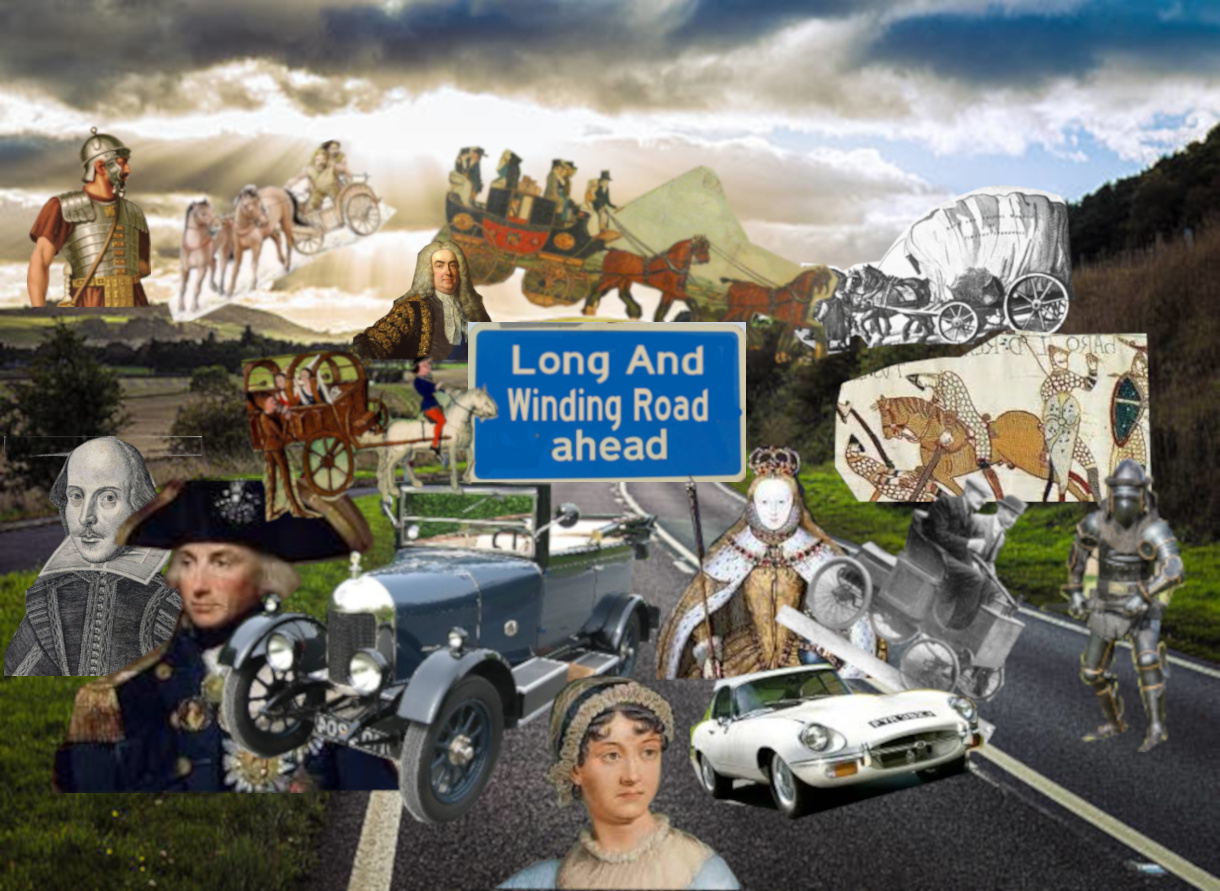
The notion of a long and winding road has become a metaphor, but it is one based on the reality that roads, real, physical structures, do wind their way across the land, as well as through our history.
Except for motorways, roads are for everyone; shared, social spaces which people have used since prehistory.i Mostly we think of roads as being for cars, lorries, buses, motorbikes, and even intrepid cyclists. But, for those who stick to walking, even the A1, as it leaves London, has a footpath running beside it, as far as Borehamwood. Remember, for most of history, people walked, and we still do. Of course, although shut in the carapace of our cars, vans, and lorries, we have to negotiate the space, even if only to avoid banging into each other. (Not that we’re a hundred percent successful!)
Walking, though, offers stronger social potential. I’m not just thinking about the likes of Chaucer’s pilgrims, but of how we still meet people as we go to the shops, wheel our toddlers out, or walk the dog. It seems to me, roads, those corridors across the landscape, often first made long ago, do more than link one place to another. They colour and shape the view we have of the world, they allow social connection, and have an impact on our economic environment.
From a day-to-day perspective, we treat roads, simply as being there, waiting for us to use them. And yet, we speak of them as if they were animate: ‘This road will take you to such a place’;’The road that runs behind the station’; ‘The road that goes to the coast’. They figure in our wise sayings: ‘It’s a long road that has no turning’; ‘The road to hell is paved with good intentions’; ‘All roads lead to Rome’. It is possible roads say more about us, and our ancestors who used them, than we realise.
What’s in a Word?
Yes, I’ve said, some roads have long histories, but what about the word road? How old is that?
Go back four centuries, or so, and the word ‘road’ is not being used in the way we do today. Throughout all of Shakespeare, you’ll only find it about a dozen times, and then, mostly, not used to mean a highway. In the King James Bible, of 1611, the word ‘road’ occurs just once, and it refers to an attack. That usage comes from the Old English word ‘rad’, meaning ‘riding, a hostile incursion’. Raid, ride, rode all come from the same root.
What were we saying, back then, instead of road?
Way and highway were probably the most common words, however, thoroughfare, street, path, lane, alley all pre-date the word ‘road’. The Saxons gave us ‘street’, by which they meant, a long distance, paved highway; for example, Ermine Street, and Watling Street. In towns with a Viking heritage, such as York, Nottingham and Peterborough, you will come across names such as ‘Coppergate’, ‘Goose Gates’, ‘Priestgate’. These names refer to streets, not the site of gates. The word ‘gate’, used in this way, is derived from the Norse ‘gata‘, which simply meant a street.
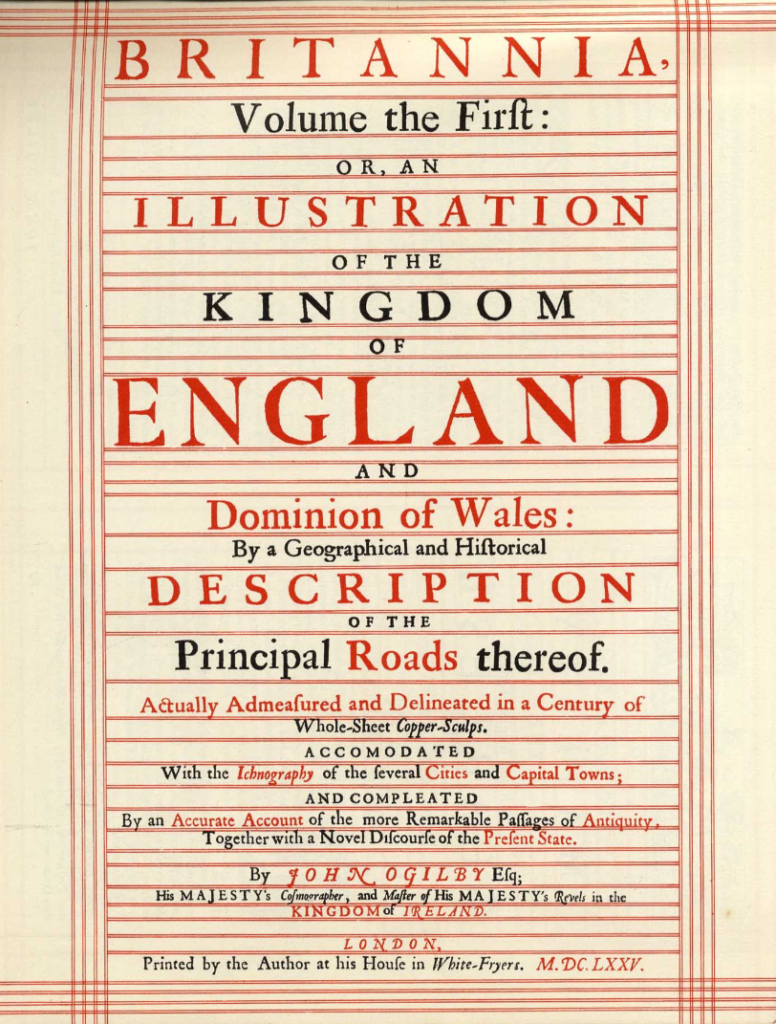
We had to wait for the second half of the seventeenth century for the meaning of road to be used as we use it. John Ogilby’s Britannia, of 1675, was subtitled: A Geographical and Historical Description of the Principle Roads thereof. Each map is headed The Road from… The word Road had arrived. We’ve hung on to highway, street, and lane, but mostly, road is king.
About me
Though History appears in the tile of this blog, I am not an historian. Given the vagaries of the schooling system, I ‘gave-up’ history at fifteen. Somehow though, history never quite gave me up. Nor, though I have driven around the place a good deal, am I a professional driver.
So why a blog linking roads and history?
I blame John Ogilby. Looking through his beautiful strip-maps, drawn in the second half of the seventeenth century, set off a new enthusiasm: the where, the who and the why of roads.
Inevitably, I’ll get things wrong, or not post about a road dear to your heart, or, perhaps, stir a memory of a road that has significance for you. Whatever the reason, please do not hesitate to use the response section at the bottom of each post. I can’t guarantee to answer each and every one, but I will certainly read them, correct errors, offer additional information, if necessary, and research aspects of a road I have neglected